
The best way to review for an Algebra 2 final exam is to focus on mixed practice, quickly identify gaps, and target the skills students actually need, instead of trying to reteach every single topic. A structured review plan helps students revisit the key concepts they’ve learned without feeling the overwhelm of having to recall the entire Algebra 2 course material.
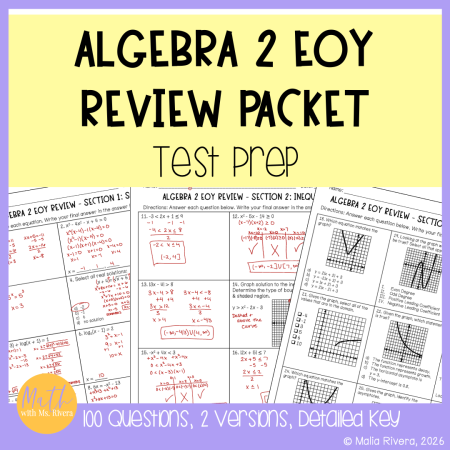
If you want something ready-to-use, I put together an Algebra 2 test prep packet that mixes these skills into a way that mirrors the exam and helps you quickly see where students are struggling.
What Should You Review for an Algebra 2 Final Exam?
One of the biggest mistakes with test prep is trying to review everything equally. Not all topics need the same amount of time and attention.
For example, should you spend the same amount of time on transformations of radical functions as solving exponential and logarithmic equations? I don’t think that’s a good use of review time.
In most Algebra 2 courses, your review should probably center around:
- Functions (this shows up everywhere!)
- Quadratics and polynomial behavior
- Exponential and logarithmic functions
- Rational expressions and equations
- Key algebra skills that will carry into future courses, like solving equations and interpreting graphs
Probability and statistics can be included, but they usually don’t need as much time as core function-based topics that students will need in Pre-Calculus and Calculus.
If you’re short on time, I recommend prioritizing the skills that:
- Connect across multiple units (i.e. transformations of functions)
- Show up in real world applications
- Your students struggled with during the year
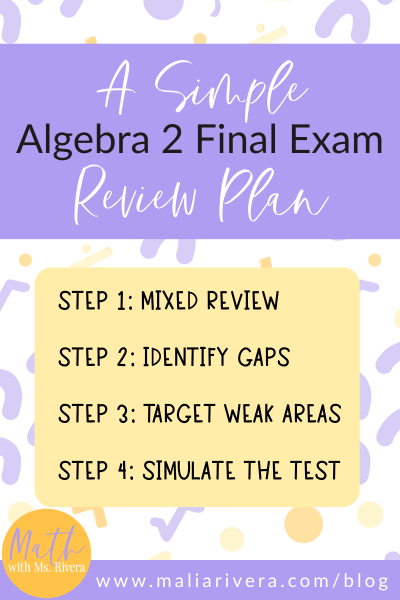
A Simple Algebra 2 Final Exam Review Plan
If you’ve ever felt like review week turns into chaos and stress, this structure can help keep things focused and manageable.
Start with Mixed Review
Instead of reviewing one unit at a time, start with mixed practice. This is going to force your students to:
- recognize what type of problem they’re solving
- switch between concepts
- think more critically
- recall skills across multiple units
It also mirrors what they’ll see on the actual exam. Even short daily mixed sets can be more effective than full “unit review days”.
Identify Gaps Quickly
You don’t need a full test to figure out what students don’t know! Instead, use:
- quick checks
- exit tickets
- short mixed problem sets
- conversations with and among students – yes, this can inform you of a lot!
If multiple students are struggling with the same type of problem, that’s where your time should go next.
Target Weak Areas
Once you see where the gaps are, shift your focus. It could look very different from the review you’ve offered in prior years. This might look like:
- pulling a small group to focus on reviewing a specific topic(s)
- assigning targeted practice
- reviewing one skill with the whole class if needed – great as a warm-up!
The goal here is not to reteach entire units or multiple connected skills at once, but to fix the specific misconceptions.
Simulate the Test
Before the actual exam, give students a chance to experience it! Now, I don’t mean that we are reviewing and teaching to the test. However, we do need to get them ready to take the test. This could be a full length practice test or a shorter version broken into sections. Doing this helps students to build stamina, manage their time, and see how topics are mixed together in various question forms.
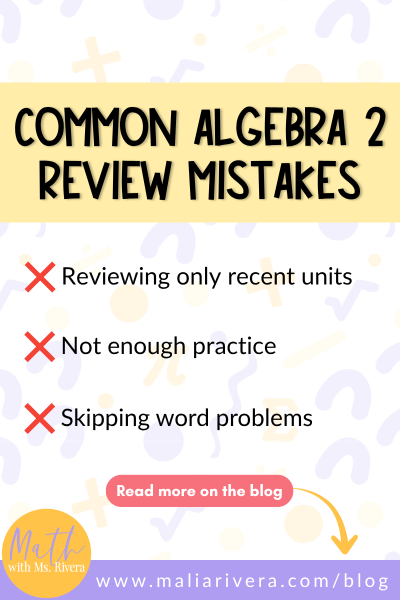
Common Mistakes During Algebra 2 Test Prep
Even with the best intensions, these are the things that tend to derail review week.
Only Reviewing Recent Units
Students often remember what they learned most recently and forget the earlier topics. Honestly, I don’t blame them! Those are topics learned 5-7 months prior. Those topics have to be reviewed! That’s why mixed review is SO important. It brings everything back together.
Focusing on Notes Instead of Practice
Looking over notes feels productive, but it doesn’t prepare students for solving problems on their own. This strategy may work better for History and Science courses, it is not the best, in my opinion, way to review math content.
Students need to actually do the math!
Avoid Word Problems
Word problems take longer and can be frustrating, so they are often skipped. But understanding, breaking down and identifying what skills you need to solve the word problem is extremely important! Plus, they do show up on exams.
If student’s don’t practice them, not only throughout the year but, during review, that’s where they’ll struggle the most.
Treating All Students the Same
Not every student needs the same review. Some need more support with foundational skills, while others are ready for more challenging problems.
Even small adjustments to differentiate among your students can make a huge difference for how prepared they are and feel for the exam.
I go more in-depth on these (and how to fix them) here.
How Long Should Algebra 2 Review Take?
Most Algebra 2 final exam review should be about 2 weeks. Really, we know that this is dependent on:
- your and your schools end of year schedule
- how much content you need to cover
- how your students performed throughout the year – this is why review looks different year to year
If time is limited, I would focus on mixed review, the most essential skills, and common problem types.
Algebra 2 Review Activities That Work
Not all review activities are equally effective. The best ones are going to mix multiple topics, require students to think (not just repeat steps) and provide feedback.
Some of the most effective options include:
- Spiral review worksheets
- Mixed practice problem sets
- Self-checking activities by topic
- Cumulative review packets
If you’re looking for something ready-to-use that already combines these skills, a structure test prep packet can save you a lot of time and ensure students are practicing the right material.
Frequently Asked Questions
Q: Should I review every unit?
A: No. Focus on the most important concepts and the areas where students struggled. It’s better to go deeper on key skills than rush through everything!
Q: How do I keep students engaged during review time?
A: Use a mix of formats. Short problem sets, self-checking activities, structured review packets all can help keep things moving without overwhelming students.
Q: What is my students are all at different levels?
A: When this occurs in my classroom, I start with mixed review, then use what you see and hear from your students to guide your next steps. Small groups, targeted practice, or even optional challenge problems can help meet different needs without creating completely separate plans.
Final Thoughts
Algebra 2 test prep doesn’t have to feel overwhelming!
When you focus on mixed review, identifying gaps, and target what actually matters, your review becomes more effective and more manageable. Honestly, it saves you a lot of time, too!


2 Responses