
The Real Number System is one of the first big review topics in Algebra 1 — and for good reason. It lays the foundation for everything else students will do with algebra, from solving equations to understanding functions. But because students often come in with patchy prior knowledge, this review can either feel like a smooth refresher… or a messy scramble.
Here’s a ready-to-go lesson plan for teaching the Real Number System that moves students through classifying, ordering, and comparing real numbers with both printable and digital resources. You can use it as-is or pull pieces that fit your style.
Warm-Up (~2-3 minutes)
Goal: Activate prior knowledge and get students talking.
Write this prompt on the board:
“In your own words, what makes a number an integer?”
Students write their response in a notebook or on a whiteboard, then share with a deskmate or table group before discussing as a class. This quick activity helps you gauge what they remember about the real number system.
Direct Instruction (~8 minutes)
Goal: Introduce or reinforce the structure of the Real Number System.
I like to start with a visual diagram of the Real Number System, moving from natural numbers all the way to irrational numbers. I like to go through the number system by comparing it to the way they learn about numbers in school. In Kindergarten they learn about how to count, 1, 2, 3, 4… Then they are introduced to the concept of “nothing” when counting as zero. Elementary school is where they learn how to count in all different ways. When they get to middle school, that’s where they are introduced to “the opposite” numbers. This is also known as integers! After they’ve learned about positive and negative whole numbers, they start learning about the parts of a whole. Aka, rational numbers and how to manipulate those. Then in 8th grade, or Pre-Algebra, you learn the difference between rational and irrational numbers.
At this point, I like to pause and emphasize rational vs. irrational with examples. Many students can name π as irrational, but stumble when asked about decimals like √2 or 0.333… (repeating).
Students often confuse rational vs. irrational, so I make sure to stop here for examples and discussion.
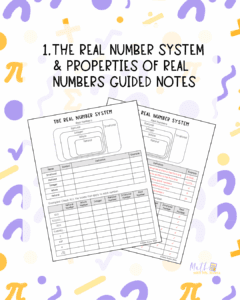
👉 If you don’t have a set of notes ready, you can use these: Real Number System & Properties of Real Numbers Guided Notes.
Optional: You can also layer in the properties of real numbers (commutative, associative, distributive, etc.) depending on how much review your students need.
Real Number System Practice Stations (~20–24 minutes)
Goal: Give students exposure to classifying, ordering, and comparing real numbers in different contexts.
I set up three stations around the room and rotate students every 10–12 minutes (on a 46-minute period). If you teach longer blocks, students can complete all three in class. If not, they can finish one as homework.
-
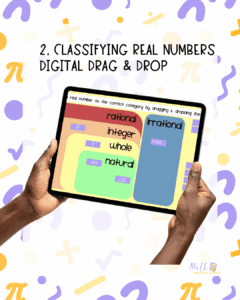
Station 1: Classifying Real Numbers
Students drag and drop numbers into categories of the Real Number System.
👉 Resource: Classifying Real Numbers Digital Drag & Drop Activity -
Station 2: Comparing Real Numbers
Students work together to compare real numbers on a collaborative fall-themed tessellation activity that doubles as a bulletin board display.
👉 Resource: Comparing Real Numbers Fall Collaborative Tessellation -
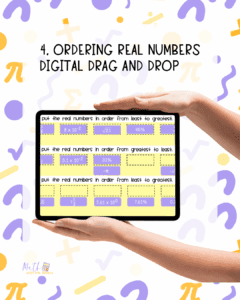
Station 3: Ordering Real Numbers
Students practice converting between decimals, fractions, and percentages while putting numbers in order.
👉 Resource: Ordering Real Numbers Digital Activity

Check for Understanding (~8–10 minutes)
Goal: Quickly assess who’s confident and who needs more review.
At the end of class, I always do a formative assessment. It can be as simple as a slap poster, an exit ticket, or a digital quick-check.
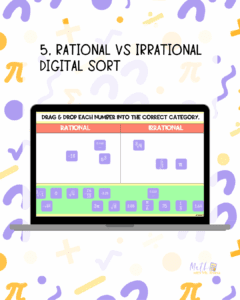
One of my favorites for this lesson is a Rational vs. Irrational sort. Students drag examples into the correct category and turn it in via your LMS. I don’t grade this — it’s just for me to see who might need reteaching.
Pro Tips for Teaching This Lesson
-
Build in transition time between stations. In Algebra 1, whether you’re teaching middle or high school, things rarely move as fast as you expect.
-
Use stations as a chance to circulate. You’ll hear the conversations and spot misconceptions before they grow.
-
Keep it light — since this is often review, the main goal is shaking off the rust and setting the tone for how math will look in your class.
The Real Number System doesn’t have to feel like a dry review. With the right structure, students get engaged, work together, and build confidence before diving into new Algebra 1 content.
If you’re ready to try it out, grab the resources I mentioned above and make this lesson your own:
Happy teaching!