

This may be an unpopular opinion, but I believe transformations of parent functions is one of the most foundational topics in Algebra 2.
Why? Because transformations show up everywhere. Students revisit them in quadratics, exponentials, logarithms, rational functions, trigonometry. Basically every unit. And cognitively, this lesson marks a big shift:
-
In Algebra 1, doing math often comes first then we connect to visuals.
-
In Algebra 2, students must do math through visuals.
That’s why I like to start the year with a structured lesson plan that sets students up for success. Below is my exact plan for teaching parent function transformations.
Warm-Up (~5 minutes)
Goal: Spark curiosity and get students looking closely at graphs.
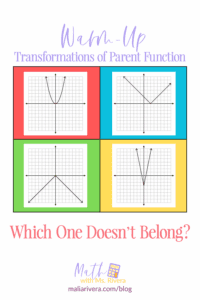
I use a “Which One Doesn’t Belong?” number sense routine. On the board, I project a 2×2 grid of four graphs — each one is the same parent function, but transformed differently.
Students think silently about reasons why each graph might “not belong,” then share with a partner before we discuss as a class.
This gets them noticing shifts, reflections, and stretches without formal vocabulary yet.
Direct Instruction (~12–15 minutes)
Goal: Teach the language and notation of transformations, no matter which parent function is given.
I begin by reviewing the list of parent functions (linear, quadratic, cubic, absolute value, square root, exponential). Then I layer in transformations one at a time:
-
Vertical and horizontal shifts
-
Reflections across the x- and y-axis
-
Vertical stretches and compressions
Each transformation gets tied to both:
-
The equation (notation change)
-
The graph (visual effect)
👉 Resource to try: Guided Notes on Parent Function Transformations.
These notes walk through examples step-by-step so students can see how a small change in notation impacts the entire graph.
Practice Stations (~20–25 minutes)
Goal: Give students ample practice with transformations in multiple forms.
I hand out a packet with three stations, but students are told to complete any two in class. This keeps them motivated to stay on task and gives them flexibility. Any unfinished station becomes homework.
-
Station 1: Graphing Parent Function Transformations
Students graph transformed functions directly.
👉 Graphing Parent Function Transformations Worksheet -
Station 2: Identifying Transformations
Students analyze equations and match them to graphs, identifying which transformations occurred.
👉 Identifying Transformations from Equations & Graphs Differentiated Circuit Worksheet -
Station 3: Writing Transformations
Students are given a graph and must write the transformed equation.
👉 Writing Transformations of Parent Functions Worksheet
I allow students to work with a partner. Because it helps me see who collaborates well (and who doesn’t!) while giving them space to talk through the math.
Check for Understanding (~1 minute)
Goal: Quickly assess how confident students feel before leaving class.
Before dismissing, I have students line up and “slap” or high-five a poster that shows their level of understanding:
-
5 (Top) = I can teach a friend
-
4 = I feel comfortable to do my homework
-
3 = I need some practice, for sure
- 2 = I need some extra help understanding
- 1 (Bottom) = Uhh… What happened today?!
This quick strategy gives me a pulse on the class and shows students that their voice matters in the learning process.
Tips for Success
-
Break the lesson into small transformation chunks — don’t throw shifts, reflections, and stretches at students all at once.
-
Use lots of color-coding and graph overlays to highlight differences between the parent function and the function after the transformations have been applied.
-
Keep the practice varied — some students connect faster with equations, others with graphs.
FAQ: Teaching Parent Function Transformations in Algebra 2
Q: Why teach transformations so early in Algebra 2?
Because the concept shows up in nearly every unit that follows. Starting early gives students a foundation they’ll keep building on.
Q: Which parent functions should I review first?
I recommend starting with linear, quadratic, and absolute value since students are already familiar with them from Algebra 1. Then add square root, cubic, and exponential.
Q: How do you explain reflections to students?
I show them a graph of f(x) and -f(x) side-by-side, then ask: “What stayed the same? What flipped?” Using visuals alongside equations makes the abstract idea stick.
Function transformations can feel overwhelming, but with a clear structure and plenty of practice, students build confidence quickly. By starting the year with this lesson, you set the stage for deeper understanding all year long.
If you’d like ready-to-use resources for this lesson, check out:
Happy teaching!